Blog

Joe Romeo's Slow-Cooker Mashed Potatoes (F-150 Powered)

Joe Romeo, Dealer Principal of Romeo Ford of Kingston, shares the side that frees up the oven.

On Thanksgiving, oven space is the most valuable real estate in the house. Joe's solution is creamy mashed potatoes made ahead and kept warm in a slow cooker, so the host has one less thing to juggle.

"A slow cooker is the ultimate travel dish. Lock the lid, wedge it in the back seat of an F-150 SuperCrew and you're good to go," Joe says. "If your truck has the available Pro Power Onboard, you can even plug it in once you're parked for the tailgate before the big game."

Ingredients

  • 5 lb Yukon Gold potatoes, peeled and cut into 2-inch chunks
  • 1 cup whole milk, warmed
  • 8 oz cream cheese, softened
  • ½ cup (1 stick) butter, plus more for the slow cooker
  • ½ cup sour cream
  • 1½ tsp salt and ½ tsp black pepper
  • 2 tbsp chopped chives

Directions

  1. Cover the potatoes with cold salted water in a large pot. Bring to a boil and cook 15–20 minutes, until a fork slides in easily. Drain well.
  2. Mash the potatoes with the milk, cream cheese, butter and sour cream until smooth. Season with salt and pepper.
  3. Butter the inside of a slow cooker and spoon in the potatoes. Top with a few pats of butter.
  4. Set to Warm (or Low) and keep for up to 4 hours, stirring once or twice. Sprinkle with chives before serving.
Joe's tip: The cream cheese is what keeps these from drying out. Add a splash of warm milk before serving if they've thickened up.

Happy Thanksgiving from the team at Romeo Ford of Kingston!

Recommended Posts

Ford Explorer vs. Expedition in Kingston | Romeo Ford

Ford Explorer vs. Expedition in Kingston | Romeo Ford

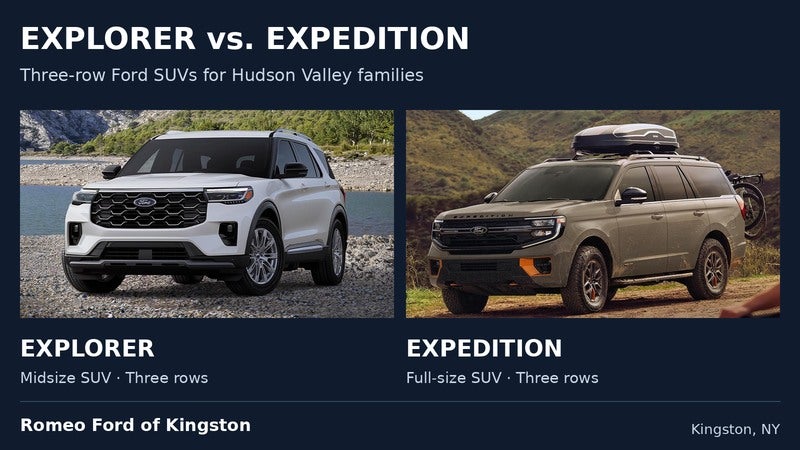
The Ford Explorer is a good fit for families who need three rows but want manageable everyday driving. The Ford Expedition is the better choice if you regularly carry seven or eight people with luggage, or tow a larger boat or camper. Both offer configurations suited to Hudson Valley driving. Here is how to choose at Romeo Ford of Kingston. How much bigger is the Expedition than the Explorer? The Explorer is a midsize SUV, while the Expedition is a full-size SUV built on a truck-based platform. The Expedition also comes in an extended MAX version for more cargo room behind the third row. If adults will ride in the third row often, the Expedition gives them more space. For families who need extra seats occasionally, the Explorer offers three-row flexibility in a smaller vehicle. Which is easier to drive every day? The Explorer’s smaller footprint makes it easier to maneuver in Kingston parking lots, fit into tighter garages, and navigate winding roads near Woodstock. It is generally the more fuel-efficient choice for daily school runs and commutes, although fuel economy depends on the engine, drivetrain, and driving conditions. The Expedition offers more room, but its size takes more consideration in tight lots in New Paltz or Rhinebeck. A test drive can help you decide how much space you want to manage every day. Which tows more? The Expedition offers greater towing capability when properly equipped. Its truck-based construction and twin-turbocharged V6 make it worth considering if you pull a travel trailer to the Adirondacks or a boat to the Hudson. The Explorer can handle a small boat or camper within its towing limits. Before choosing either SUV, compare your trailer’s loaded weight with the specific vehicle’s towing rating, equipment, and passenger load. Our team can help you check the configuration you are considering. Are both good in Hudson Valley snow? Both offer equipment that can help with winter traction. The Explorer is available with Ford’s Intelligent 4WD, while the Expedition offers available four-wheel drive. Selectable drive modes help drivers adapt to different road conditions. The drivetrain is only part of the picture. Appropriate tires, good tread, and careful driving still matter on snowy mornings along Route 28 or the Thruway. What trims are available? For 2026, both SUVs offer Active, upscale Platinum, and off-road-focused Tremor models. The Explorer also offers ST-Line and performance-oriented ST models, while the Expedition offers King Ranch. The right trim depends on your priorities. Some families want straightforward everyday comfort, while others prefer upgraded seating, additional technology, or equipment for trips off pavement. Features and packages vary, so compare the actual vehicles before deciding. How do the cabins and tech compare? Both SUVs offer large displays, smartphone integration, and Ford driver-assist technology. Available Ford BlueCruise provides hands-free highway driving on compatible roads, with driver attention required. Availability and service plans depend on the trim and equipment. The Expedition provides more room for passengers and gear, especially on trips with a full crew. The Explorer offers modern cabin technology in a vehicle that takes up less space on the road and in your driveway. Explorer or Expedition: who should buy which? Choose the Explorer if you want three rows, easier parking, and generally better fuel efficiency. Choose the Expedition if you regularly fill the seats, carry more gear, or need greater towing capability. Choose the Expedition MAX if cargo room behind the third row is a priority. Browse our new Ford Explorer inventory and new Ford Expedition inventory to compare current choices. Which is better for road trips and weekend getaways? For a family of four heading to Lake George or the Jersey Shore, the Explorer offers room for passengers and luggage without the footprint of a full-size SUV. Families who regularly travel with six or more people, sports equipment, coolers, or a dog may appreciate the Expedition’s extra space. The MAX provides additional cargo room when the third row stays upright. Think about your busiest weekend when comparing sizes. Check how your passengers and luggage fit together, especially if everyone needs a seat. Can I compare both with the third row folded? Ask our team to show you the seating arrangements and folded cargo areas on available vehicles. Compare third-row access, loading height, and how easily you can move between passenger space and cargo space. Bring your car seats, stroller, or commonly used gear if those items will help you judge the fit. Visit Romeo Ford of Kingston at 128 Route 28, Kingston, NY 12401, serving Saugerties, Lake Katrine, and the Hudson Valley. Browse our new SUVs in Kingston, explore current Ford specials, or apply for financing online. Call 845-338-7800 to check availability and arrange a test drive. Frequently Asked Questions Is the Ford Explorer a three-row SUV? Yes. All 2026 Explorer models have three rows. Seating capacity is six or seven people, depending on the trim and second-row seating configuration. Which is bigger, the Explorer or the Expedition? The Expedition is larger. It is a full-size SUV with more passenger and cargo space. The extended Expedition MAX provides additional cargo room behind the third row. Does the Expedition come with four-wheel drive? Yes. Four-wheel drive is available, with availability and standard equipment depending on the trim and configuration. Can the Ford Explorer tow a camper? The Explorer can tow a camper that falls within its towing limits when properly equipped. For a larger travel trailer, consider a properly equipped Expedition and confirm the loaded trailer weight before choosing. Where can I test drive an Explorer or Expedition near Kingston? Contact Romeo Ford of Kingston at 128 Route 28, Kingston, NY 12401. Call 845-338-7800 or browse current inventory online to check availability and arrange a test drive.

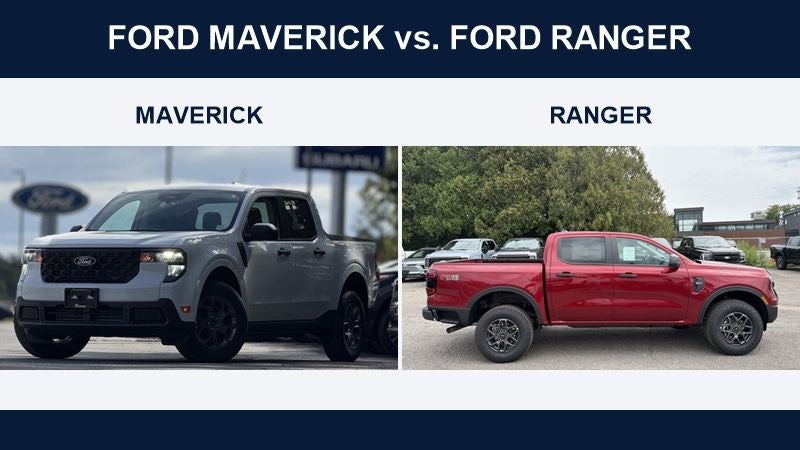
Ford Maverick and Ford Ranger parked side by side at Romeo Ford of Kingston NY

Ford Maverick vs. Ranger in Kingston | Romeo Ford

Pick the Ford Maverick if you want a compact, fuel-sipping pickup for errands, weekend projects, and easy parking. Pick the Ford Ranger if you tow a boat or camper, go off-road, or need a true body-on-frame midsize truck. Both are smaller and easier to live with than an F-150. Here is how Romeo Ford of Kingston helps local drivers choose. What is the biggest difference between the Maverick and Ranger? How they are built. The Maverick uses a unibody design, like an SUV, so it rides and handles more like a car. The Ranger is a traditional body-on-frame truck, built for heavier towing and rougher terrain. That one difference shapes almost everything else, from ride comfort to how much trailer you can pull. Which one gets better fuel economy? The Maverick. It comes standard with a hybrid powertrain, which makes it one of the most efficient pickups you can buy. It is a great fit if you commute from Saugerties or Woodstock into Kingston every day. The Ranger uses turbocharged gas engines that trade some efficiency for more power and towing muscle. Shop new Ford Maverick to see what is in stock. Which is better for towing? The Ranger. Its frame and stronger engines let it tow considerably more than the Maverick. If you pull a boat to the Hudson, a camper to the Catskills, or a trailer full of firewood, the Ranger is the safer bet. The Maverick can handle light loads like a small utility trailer or a pair of jet skis when properly equipped. Ask our team for the exact towing capacity of the truck and equipment you’re considering, or shop new Ford Ranger inventory. Are the Maverick and Ranger good in snow? Yes, when equipped right. The Ranger offers available four-wheel drive, which is great for unplowed roads in Woodstock or steep driveways near New Paltz. The Maverick offers available all-wheel drive, which handles slick pavement and light snow well. Either way, a set of winter tires makes a big difference on Hudson Valley hills. Which is better off-road? The Ranger, especially in off-road trims and the high-performance Ranger Raptor. It has the ground clearance and hardware for trails and rutted camp roads. The Maverick offers an off-road-themed Tremor package that adds capability for dirt roads and light trails, but it is not built for hard-core rock crawling. What about bed space and daily usability? The Maverick's compact bed is designed for do-it-yourself projects. It has clever tie-down points and slots for building your own dividers and racks. It fits easily in a Rhinebeck parking spot or a tight home garage. The Ranger offers a larger, tougher bed for heavier gear and more payload. Maverick vs. Ranger: quick summary Maverick: standard hybrid, car-like ride, easy to park, available AWD, light-duty towing. Ranger: body-on-frame toughness, more towing and payload, available 4x4, serious off-road trims. Both: smaller footprint than an F-150 and Ford's modern tech. Which is better for a first truck or a growing family? For a first truck, many Kingston buyers start with the Maverick. It feels familiar if you are coming out of a sedan or small SUV, and the crew cab seats a small family. It also costs less to fill up week to week thanks to its hybrid system. Families who camp, hunt, or haul a lot of gear often grow into the Ranger. Its stronger frame and towing ability give room for bigger hobbies later. Think about where you will be in three to five years, not just next month. If a boat or camper is in your plans, the Ranger will save you a second purchase. What about service and long-term ownership? Both trucks are backed by Ford's factory warranty coverage, and both can be serviced right here at our Kingston service department. Regular oil changes, tire rotations, and a pre-winter inspection keep either pickup ready for Ulster County roads. Schedule Ford service online anytime. Still deciding? Drive both back to back at Romeo Ford of Kingston, 128 Route 28 in Kingston. Browse current inventory, check our Ford specials in Kingston, and value your trade-in online. Our team will help you match the right pickup to your Hudson Valley life. Frequently Asked Questions Is the Ford Maverick a real truck? Yes. It has an open bed and can tow light loads, but it uses a unibody design, so it rides more like an SUV than a traditional truck. Can the Ford Maverick tow a camper? Only small, light campers when properly equipped. For larger campers, the Ford Ranger is the better choice. Does the Maverick come with AWD? Yes, all-wheel drive is available. Ask Romeo Ford of Kingston which versions of the Maverick offer it. Is the Ranger bigger than the Maverick? Yes. The Ranger is a midsize, body-on-frame truck with more towing and payload capacity than the compact Maverick. Where can I test drive a Maverick or Ranger near Kingston? At Romeo Ford of Kingston, 128 Route 28. Call 845-338-7800 or check current inventory online.

america 250

America’s 250th Anniversary: Celebrating 250 Years of Freedom, Innovation & the American Drive

A Once-in-a-Generation Celebration of America—and the Vehicles That Helped Move Us Forward In 2026, the United States will celebrate America’s 250th anniversary, also known as the Semiquincentennial. This historic milestone marks 250 years since the signing of the Declaration of Independence in 1776. Across the country, communities, families, businesses, schools, and local organizations will come together to celebrate American history, reflect on how far we’ve come, and look ahead to the future. For those of us in the automotive world, America’s 250th anniversary is also a perfect time to look at something that has been central to American life for generations: the automobile. From horse-drawn wagons and dirt roads to gas-powered engines, family SUVs, electric vehicles, advanced safety systems, and high-tech driver assistance features, the American driving experience has changed dramatically. Cars have helped families travel farther, businesses grow faster, communities connect more easily, and generations of drivers experience freedom on the open road. As we celebrate 250 years of America, we’re also celebrating 250 years of movement, progress, invention, and the drive to keep going. From Horse and Buggy to Horsepower Before cars filled driveways and highways, most Americans relied on horses, wagons, carriages, walking, trains, and eventually bicycles to get around. Daily travel was slower, more difficult, and often limited by weather, terrain, and distance. Then came the rise of the automobile. The early gas-powered vehicle changed everything. It gave people more independence, made travel more personal, and helped shape the modern American lifestyle. Suddenly, families could visit relatives in other towns, workers could commute farther, and small communities became more connected to larger cities and markets. The automobile did more than move people. It changed America. Highlights in the Evolution of the Automobile Here are just a few major ways vehicles have progressed over the years: Horse-drawn transportation: Before the automobile, horses and wagons were the everyday standard for many families and businesses. Gas-powered engines: Internal combustion engines gave drivers more speed, distance, and independence. Mass production: Assembly-line manufacturing helped make cars more affordable for everyday Americans. Electric starters: Early drivers once had to hand-crank engines. Electric starters made vehicles easier and safer to operate. Closed cabins and heat: Cars became more comfortable and practical in all kinds of weather. Automatic transmissions: Driving became easier and more accessible for millions of people. Power steering and power brakes: Larger vehicles became easier to handle. Air conditioning: Road trips became much more comfortable, especially during the summer. Seat belts, airbags, and crash testing: Safety became one of the biggest priorities in automotive design. SUVs, trucks, and family vehicles: Cars evolved to fit work, family, recreation, towing, travel, and everyday life. Hybrid and electric vehicles: Today’s vehicles are becoming more efficient, more advanced, and more connected. Driver assistance technology: Features like backup cameras, blind spot monitoring, lane keeping assist, adaptive cruise control, and automatic emergency braking are changing the way we drive. Cool Car Features That Changed the Way Americans Drive Over the decades, certain vehicle features became turning points in automotive history. Some were created for convenience. Others were designed for comfort, safety, or performance. Today, many features we take for granted were once major innovations. The Electric Starter Early vehicles often required a hand crank to start the engine. That could be difficult and even dangerous. The electric starter helped make cars more practical for everyday drivers and opened the door for wider vehicle ownership. The Automatic Transmission Manual shifting was once the standard. The automatic transmission made driving easier, especially in traffic and city driving. It also helped make vehicles more approachable for a wider range of drivers. Automotive Air Conditioning Today, we barely think twice about turning on the A/C. But when air conditioning first appeared in vehicles, it was a luxury. Over time, it became one of the most appreciated comfort features, especially for family road trips and summer driving. Seat Belts and Airbags Vehicle safety has come a long way. Seat belts, airbags, crumple zones, crash testing, and stronger vehicle structures have helped protect drivers and passengers for generations. Backup Cameras Backup cameras are now common in modern vehicles and have become an important safety feature. They help drivers see behind the vehicle, making parking, backing up, and navigating tight spaces easier. Touchscreens and Connected Technology Modern vehicles now offer features that once sounded futuristic: touchscreen displays, smartphone integration, navigation, voice commands, wireless charging, remote start apps, and over-the-air updates. Hybrid and Electric Vehicles The latest chapter in automotive history includes hybrid, plug-in hybrid, and electric vehicles. These vehicles continue the story of innovation, giving drivers new ways to think about efficiency, performance, and the future of transportation. America’s Love Affair with the Open Road Few things feel more American than a road trip. For generations, cars have been part of some of life’s biggest moments: Bringing a new baby home from the hospital Taking family vacations Driving to a first job Heading off to college Buying a first car Towing a camper, boat, or trailer Taking the scenic route just because Visiting grandparents, friends, and favorite hometown places Driving in parades, community events, and holiday celebrations As America celebrates 250 years, vehicles remain deeply connected to our memories, our milestones, and our sense of freedom. The Road Ahead: What Will the Next 250 Years Bring? As we look toward America’s future, the automobile will continue to evolve. Vehicles are already becoming safer, smarter, more efficient, and more personalized. The next generation of cars may bring even more advanced electric technology, improved battery range, expanded charging networks, enhanced driver assistance systems, and new ways for drivers to stay connected. But one thing will remain the same: people will still need vehicles that fit their lives. Whether it’s a reliable sedan, a rugged truck, a family-friendly SUV, a hardworking commercial vehicle, a sporty performance model, or an electric vehicle built for the future, the automobile will continue to play a major role in how Americans live, work, travel, and connect. Celebrating America’s 250th Anniversary Locally America’s 250th anniversary is not just a national celebration. It is also a local one. Communities across the country will celebrate with parades, festivals, fireworks, historic events, service projects, and hometown gatherings. For local dealerships, this milestone is a wonderful opportunity to celebrate: American history Community pride Local families Road trip memories Automotive innovation The freedom of the open road The future of driving As we celebrate America’s 250th anniversary, we also celebrate the generations of drivers, workers, families, technicians, sales professionals, manufacturers, and innovators who helped move this country forward. From horse and buggy to horsepower, from hand cranks to push-button start, from paper maps to built-in navigation, and from gas engines to electric vehicles, the story of the automobile is part of the American story. And the road ahead is just getting started. Top Questions About America’s 250th Anniversary 1. What exactly is America’s 250th anniversary? America’s 250th anniversary marks 250 years since the signing of the Declaration of Independence in 1776. The milestone will be celebrated in 2026 and is often called the Semiquincentennial. 2. When is America’s 250th anniversary? The main anniversary date is July 4, 2026. Many events and celebrations will take place throughout 2026, leading up to Independence Day. 3. Why is America’s 250th anniversary important? It is a once-in-a-generation milestone that gives Americans an opportunity to celebrate the country’s history, reflect on the past, honor local communities, and look ahead to the future. 4. What kinds of events will happen for America’s 250th anniversary? Events may include parades, fireworks, festivals, community gatherings, historical exhibits, service projects, concerts, school programs, and local celebrations. Many activities will be community-led, meaning towns, businesses, schools, and organizations can create their own ways to participate. 5. How is America’s 250th anniversary connected to automotive history? The automobile has played a major role in American life. Cars helped families travel farther, businesses expand, communities connect, and people experience more freedom and mobility. Looking back at automotive history is a fun and meaningful way to celebrate American innovation. 6. What are some of the biggest milestones in car history? Some major automotive milestones include the rise of gas-powered engines, the introduction of mass production, electric starters, automatic transmissions, air conditioning, seat belts, airbags, backup cameras, hybrid vehicles, electric vehicles, and advanced driver assistance technology. 7. How can local businesses participate in America’s 250th anniversary? Local businesses can participate by supporting community events, sponsoring parades or festivals, creating patriotic promotions, highlighting local history, sharing customer stories, volunteering, or partnering with local nonprofits and civic organizations. 8. What does America’s 250th anniversary mean for local communities? For local communities, America’s 250th anniversary is a chance to celebrate hometown pride, honor local history, bring people together, and create memorable events for families, neighbors, and businesses. 9. How will the 250th anniversary be different from the 1976 Bicentennial? The 250th anniversary will likely include more digital engagement, broader local participation, and a greater focus on telling stories from communities across the country. While the 1976 Bicentennial was a major national celebration, the 2026 anniversary is expected to include many local and grassroots events. 10. What is a fun way to celebrate America’s 250th anniversary? A fun way to celebrate is to take a classic American road trip, attend a local parade, visit a historic site, support a community event, volunteer locally, or learn more about the history of American transportation and innovation. Final Thought America’s 250th anniversary is a celebration of history, freedom, community, and progress. For 250 years, America has continued to move forward—and for more than a century, the automobile has helped drive that story. From the earliest roads to today’s modern highways, from the first engines to the latest electric vehicles, the American journey has always been about possibility. Here’s to 250 years of America—and to the road ahead. A few key facts used here were checked against official and automotive-history sources: America250 states that July 4, 2026 commemorates the 250th anniversary of the signing of the Declaration of Independence; the U.S. DOT/NHTSA rule required rear visibility technology on vehicles under 10,000 pounds manufactured on or after May 1, 2018; Cadillac introduced the electric self-starter in 1912; Packard introduced automotive air conditioning in 1939/1940; and Oldsmobile’s Hydra-Matic became a major early automatic transmission milestone around the 1940 model year. ( america250.org)